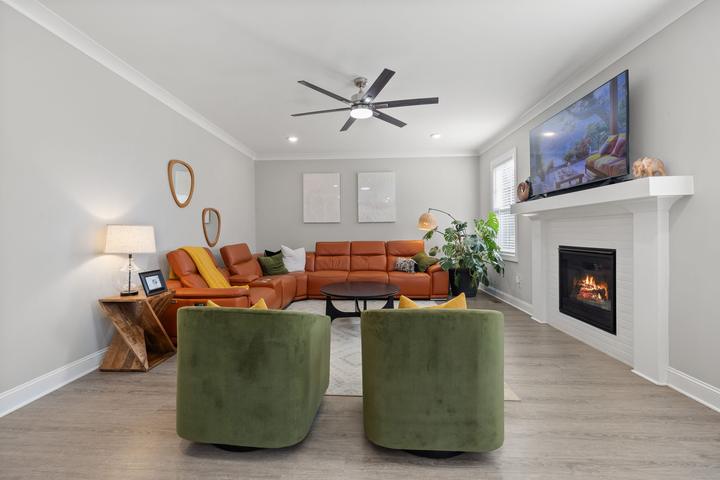
Direct vent fireplaces are sealed gas appliances that take combustion air from outdoors and send all exhaust outdoors through two pipes, one inside the other. Heat & Glo calls it a sealed combustion system. The glass front keeps the flame separate from room air, so the vent, not a chimney, is the part that matters.
How a direct vent fireplace breathes
Heat & Glo's venting explainer describes direct vent in one sentence: it is a sealed combustion system that draws outside air for the fire and expels all of the exhaust outside the home. The firebox is closed off from the room by a high-temperature glass panel, so flames and combustion byproducts stay separate from the air you breathe.
The two flows share a pair of rigid pipes set one inside the other, called a coaxial vent. The inner pipe carries exhaust out, and the outer pipe brings fresh air in to the bottom of the sealed firebox. Heat & Glo says the inner flue is 4 inches and the outer is either 6 5/8 or 8 inches, and that the outer pipe also insulates nearby combustible parts from heat.
Through the wall or through the roof
Most direct vent fireplaces vent horizontally through a wall, with pipe running from the back of the unit to a termination cap outside, and they can also be routed vertically through the roof. Heat & Glo says a through-wall vent is the simple choice for a fireplace on an exterior wall, and a vertical run is needed for a fireplace on an interior wall or an insert in an existing masonry chimney.
The cap's position matters. The page points out that fumes and noise come from the termination, which is something to think about before putting one beside a patio or a deck. A Hearth & Home Technologies product director says on the Heat & Glo page that most direct vent appliances allow up to three elbows and 40 feet of pipe, and the limit for any unit is in its own manual.
Direct vent, B-vent and vent-free compared
Gas fireplaces vent in one of three ways, and the difference is where the combustion air comes from.
Direct vent: sealed, takes outside air and sends all exhaust outside through a coaxial pair.
B-vent, or natural vent: not sealed, draws combustion air from the room and sends exhaust up through a roof pipe, so it must vent vertically.
Vent-free: no pipe at all, and prohibited in some states and municipalities according to Heat & Glo's page.
Direct vent gas fireplace inserts and the fuel question
Sealed glass front
Sealed firebox
Gas valve and controls
Inner pipe: exhaust out
Outer pipe: outside air in
Vent termination
A direct-vent gas fireplace on an outside wall, simplified and not to scale, with the inner pipe with exhaust out picked out in colour.
An insert is a direct vent unit made to fit an existing masonry fireplace. Heat & Glo says it is vented through the old chimney, often with two flexible 3 inch aluminum liners side by side, one for fresh air and one for exhaust. The page calls that a colinear system and says the insert is still sealed off from the home, with all exhaust going outside.
Direct vent describes how the unit breathes, not which gas feeds it. Whether a given direct vent unit runs on propane or natural gas is stated in its own manual and rating plate.
What a technician checks on a direct vent system
Because the whole system is sealed, its parts depend on each other. A tech checks the pieces below.
Termination cap: clear of debris and nests, and in the clearances the manual shows, since both the exhaust and the intake air pass through it.
Coaxial pipe joints: locked and sealed along the whole run, with the elbow count and length inside the manual's limits.
Glass front and its seal: the sealed glass panel is what separates flame from room air, so a gap or crack matters.
Pilot and gas valve: Heat & Glo says gas flow stops when the pilot light goes out, so a unit that keeps going out has a problem to find.
Controls: a wall switch on a gas unit is a low-voltage circuit, as the Lennox Hearth manual shows, and never a 120-volt connection.
Safety around a sealed gas unit
A direct vent fireplace still needs the same care as any gas appliance. The US Fire Administration advises annual professional cleaning and inspection of heating equipment and vents, and a carbon monoxide detector is one of the built-in safety features Heat & Glo lists around gas fireplaces. If you smell gas, leave the house and call the gas utility from outside.
Next step for a Sarasota gas fireplace
Gas fireplace owners in Sarasota, Venice and Bradenton can turn to a locally owned, family-run company, Proudly American, whose experienced crew services sealed gas units. Fireplace repair covers the vent, the glass and the controls. The first visit is a free inspection with a written estimate.
Sources
Heat & Glo, gas fireplace venting explained: direct vent definition, coaxial pipe sizes, wall or roof, B-vent and vent-free, inserts and colinear liners, pilot shutoff, carbon monoxide detectors, elbows and length
With a coaxial vent pipe that runs through an exterior wall or up through the roof to a termination cap, as Heat & Glo describes. Pipe size, the number of elbows and the cap clearances come from that unit's manual. Installing the vent is a gas installer's job, since the pipe, the seals and the gas connection form one sealed system.
What does direct vent mean?
Direct vent means the fireplace is sealed from the room and uses outdoor air for combustion. All exhaust leaves through a pipe to the outside, and the fresh air comes in through the outer pipe of the pair. Heat & Glo calls it a sealed combustion system.
What does fireplace direct mean?
It is usually shorthand for direct vent. A direct vent fireplace has a sealed firebox with glass front and a coaxial pipe to the outdoors. If a listing or label says something else, the unit's manual or rating plate defines the term.
Book Within 72 Hours of Your Free Inspection and Save 10%
Any service you book within 72 hours of your free inspection comes with 10% off. The written estimate is free either way.
Damaged firebox surfaces, or another change you have noticed.
Review the recommendation
Understand the proposed task, relevant materials and access.
Authorize the work
Agree on the price and the scope before the paid job begins.
Keep the work record
Retain the component details and any remaining recommendations.
Ready When Your Chimney Is
Call our family-run office in Sarasota for a free inspection, or send the short form and we will call back to set a time. We cover Sarasota and Venice in Sarasota County and Bradenton in Manatee County, and nowhere else.