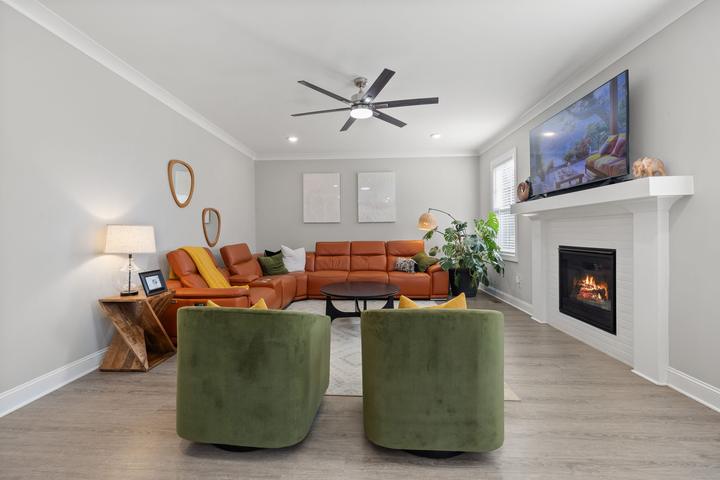
The fireplace flue is the passage that carries smoke and hot gases from the firebox up and out of the chimney. The rising gases pull air in under the fire, which is called draft. The damper sets how open the passage is, and the liner keeps heat and gases off the brick and the framing around it.
The path smoke takes, part by part
On a masonry fireplace the flue is not one pipe but a route with several parts. Smoke leaves the fire, passes the damper, spreads into the smoke chamber, enters the liner and climbs to the top of the chimney. The Florida Building Code, Residential, chapter 10, sets rules for most of those parts, and the Brick Industry Association's Technical Note 19A describes how they are built.
Firebox: where the fire burns, with the opening at the front.
Damper: a metal plate at the throat that opens and closes the route.
Smoke shelf and smoke chamber: the space above the damper where the gases gather and narrow toward the liner.
Flue liner: the lined channel running up through the chimney.
Chimney cap and rain cap: the top of the route, which sheds water and keeps out debris.
What draft is and why the fire needs it
Makeup air
Room air feeding the fire
Fireplace
Smoke and gases rising
Top of the flue
The house
Simplified drawing, not to scale. The fireplace is marked in colour.
A fire needs a steady supply of air, and the flue is how it gets one. Hot gases from the fire are lighter than the air around them, so they rise up the flue and leave. That upward flow pulls fresh air across the fire from the room, and the movement is draft.
The Brick Industry Association notes that the air for combustion and draft can come from outdoors, and that a fireplace which draws it from the house uses heated room air. This is why a fireplace that burns well can still make a house feel cold, and why a flue that is open when no fire burns lets conditioned air out.
The damper and the "open flue" fireplace
Flue
Damper
Smoke shelf
Chimney masonry
A simplified view of an open masonry fireplace seen from the side. The flue is the part this page is about.
Section R1001.7.1 of the Florida Building Code requires a masonry fireplace to have a ferrous metal damper at least 8 inches above the top of the opening, in the fireplace or in the chimney, and operable from the room. Open it fully before any fire. Close it when the fireplace is cold. Section 19A calls tight-fitting dampers one of the key points of an energy-efficient fireplace.
Searchers who ask about an open flue fireplace usually mean one with the damper left open. A flue left open lets in rain, leaves, animals and drafts. If the handle will not move, read how to fix a stuck chimney flue. A plug is the other way to stop drafts, covered in fireplace flue blockers.
Why the size and lining of the flue matter
A flue that is too small cannot carry the smoke of the fire it serves. Section R1003.14 says a chimney flue may not be smaller in area than the connector from the appliance, and the chapter's summary table says the effective flue area for a fireplace is based on the area of the opening. Table R1003.14(1) lists a round 12-inch flue at 113 square inches and a round 8-inch flue at 50.
Section R1003.11 says masonry chimneys must be lined, with a lining suited to the appliance. R1003.12 requires clay liners to be installed to ASTM C1283 and carried up vertically. For a factory-built or gas appliance the liner and vent follow the maker's listing and instructions, so check that manual first.
How high the flue ends and what protects the top
Section R1003.9 says a chimney must extend at least 2 feet higher than any part of a building within 10 feet, and at least 3 feet above the highest point where it passes through the roof. Section R1003.9.1 asks for a concrete, metal or stone cap with a drip edge, sloped to shed water. Where a rain cap is fitted, R1003.9.3 says the net free area under it must be at least four times the area of the flue outlet.
Signs the flue is not doing its job
Most flue problems show up as smoke in the wrong place.
Smoke or an acrid smell comes into the room when a fire is lit.
The fire is slow to catch, burns lazily or smolders.
The damper handle is stiff, loose or does not move the plate.
Water, rust or debris lies on the smoke shelf or in the firebox after rain.
Daylight, a bird sound or a draft comes down a closed damper.
What you can check, and when to stop
With the fireplace cold, check that the damper handle is fully open and look up the flue with a flashlight for anything blocking the way. Do not climb on the roof. A fall from a roof is a real risk, and the cap can be seen from the ground.
Stop and call if smoke spills into the room, a carbon monoxide alarm sounds, the damper will not open, or you see a blockage or a broken liner. Do not light another fire until the flue is checked. The US Fire Administration advises having chimneys cleaned and inspected every year by a professional.
What a flue inspection covers
A technician looks at the damper and its seating, the smoke chamber and shelf, and the liner along its length, and checks the cap and the crown at the top. The inspection looks for buildup that restricts the flue, cracks that let heat reach the masonry, and water damage. The next step is a written estimate for whatever repair is needed. See fireplace repair for the work involved.
When you do not know what is in your flue
If the fire smokes, a damper sticks or you simply do not know what is in your flue, we can look. Sarasota Chimney Repair is a locally owned, family owned and operated company with an experienced crew, Proudly American. Ask for a free on-site inspection and a written estimate.
Most often the damper is not fully open or something is blocking the flue, such as a nest or debris at the cap. Check the damper first with the fireplace cold, then look up the flue with a flashlight. If smoke still comes into the room, stop using the fireplace and have the flue inspected.
How to seal fireplace flue?
The built-in seal is the damper, which should close tightly when the fireplace is not in use. A damper that no longer closes is a repair job. Removable plugs are a temporary measure with their own risk of being left in during a fire, which our flue blocker guide explains.
How to open the fireplace flue?
The Florida Building Code requires the damper to be operable from the room with the fireplace, so look for a handle or other control in the firebox or at the front. Move it until the plate stands fully open, then look up with a flashlight to be sure the way is clear. A control that will not move should not be forced.
Book Within 72 Hours of Your Free Inspection and Save 10%
Any service you book within 72 hours of your free inspection comes with 10% off. The written estimate is free either way.
Damaged firebox surfaces, or another change you have noticed.
Review the recommendation
Understand the proposed task, relevant materials and access.
Authorize the work
Agree on the price and the scope before the paid job begins.
Keep the work record
Retain the component details and any remaining recommendations.
Ready When Your Chimney Is
Call our family-run office in Sarasota for a free inspection, or send the short form and we will call back to set a time. We cover Sarasota and Venice in Sarasota County and Bradenton in Manatee County, and nowhere else.