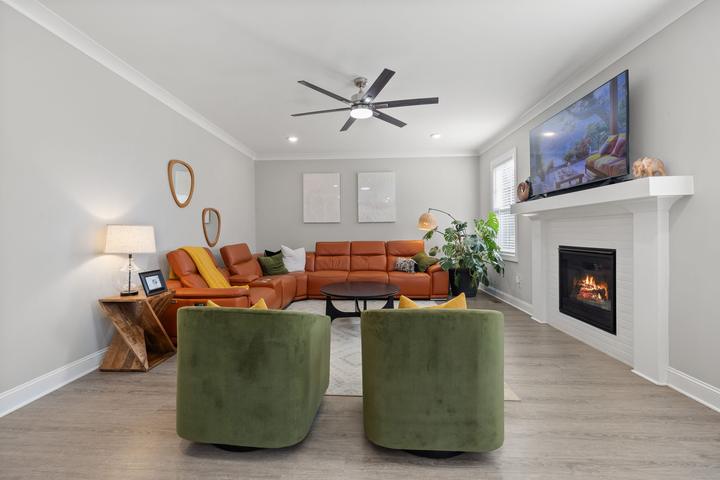
Insulating a fireplace opening safely means using fire-resistant materials such as sheet metal or sheetrock with furnace cement caulk, not loose insulation or foam. Close the damper, add tight-fitting glass doors and, for an unused fireplace, use a removable cover or a flue plug that you take out before any fire.
What insulating the opening really means
Most of the air a fireplace loses goes up the flue or around the opening, so insulating the opening is mostly about closing paths. The Department of Energy tells homeowners to check that fireplace dampers close properly, to consider an inflatable chimney balloon to seal the flue when not in use and to seal air leaks around fireplace chimneys with fire-resistant materials.
Notice what is missing from that list. It never suggests stuffing the firebox with fiberglass, foam or rags.
Materials that belong near a fireplace and ones that do not
The Brick Industry Association says combustible material should not be placed within 6 inches of a fireplace opening in the plane of the front wall, and the U.S. Fire Administration says to keep anything that can burn at least 3 feet from a fireplace. Insulation that is meant for a wall is usually made of combustible material, so it does not belong inside a firebox or against the opening.
Right for gaps around the opening and chimney. Sheet metal, sheetrock and furnace cement caulk, as the Department of Energy lists.
Right for a rarely used flue. An inflatable chimney balloon, removed before any fire, or a damper that actually seals.
Wrong anywhere near the fire. Loose fiberglass, spray foam, rolled towels, cardboard and newspaper.
Insulating a fireplace you still use
Flue
Damper
Lintel
Chimney masonry
Where the damper sits: an open masonry fireplace seen from the side, drawn simply and not to scale.
A working fireplace should stay ready to use, so the answer is the layers that come off easily. Keep the damper in good working order, since the Brick Industry Association recommends a tight-fitting damper. Fit tight-fitting glass doors that are sealed around the edges and kept closed when the fireplace is idle. Our guide on blocking a fireplace draft covers each layer.
Remember that glass doors have limits. The notes caution that running a fire with doors closed can warp metal and strain the lintel and joints.
Insulating an unused fireplace
If nobody will light the fireplace again, you have more freedom, but the same rules apply to materials. Cover the opening with a snug panel of sheet metal or fire-resistant board, seal its edges with furnace cement caulk and keep the damper shut. Label the panel so a guest does not light a fire behind it.
For a permanent answer, read our guide to taking a fireplace out of service, which explains what has to be done about the damper, the flue and any ash pit.
What about a fireplace chase
A chase is the framed enclosure that houses a prefabricated fireplace and its metal chimney, often with a wall around it. Gaps and unsealed boxes around it can let air in just as an open damper does. Insulation that touches a metal chimney or sits against a firebox can be a fire hazard, and the clearances come from the unit maker's instructions. Do not add insulation around one without that manual or a technician's advice.
When the opening needs more than insulation
If you can see daylight around the damper, feel air pour from the opening or find gaps in the brick, the cause is a repair. Sarasota Chimney Repair is a locally owned, family owned and operated crew with experienced technicians, and we are Proudly American. Ask about fireplace installation and closing options and request a free inspection and a free written estimate.
Close the damper, fit sealed glass doors and fill gaps around the opening with fire-resistant material such as sheet metal, sheetrock and furnace cement caulk, as the Department of Energy advises. For a rarely used flue, use an inflatable chimney balloon that comes out before each fire. Keep loose insulation and foam out of the firebox.
Can i use my open fireplace?
Yes, if the fireplace and chimney are in good order, and checking that is the point of the yearly cleaning and inspection the U.S. Fire Administration recommends. Keep anything that can burn at least 3 feet away, keep doors closed except when loading, as the EPA says, and put ashes in a covered metal container. Remove any cover or plug first.
How to block a fireplace opening?
A temporary block is a snug panel of fire-resistant board or sheet metal, sealed at the edges and removed before any fire. A permanent block changes the damper, flue and structure and is a construction job, not an insulation fix. Our guide on closing a fireplace explains the options.
Book Within 72 Hours of Your Free Inspection and Save 10%
Any service you book within 72 hours of your free inspection comes with 10% off. The written estimate is free either way.
Tell us where water, soot or damage appeared and when you first noticed it.
Review the condition
We look at the relevant system and separate the symptom from the component requiring attention.
Agree on the work
Choose the proposed service after the materials, access and price have been explained.
Understand the result
We review the completed work and any operating or maintenance questions that remain.
Ready When Your Chimney Is
Call our family-run office in Sarasota for a free inspection, or send the short form and we will call back to set a time. We cover Sarasota and Venice in Sarasota County and Bradenton in Manatee County, and nowhere else.