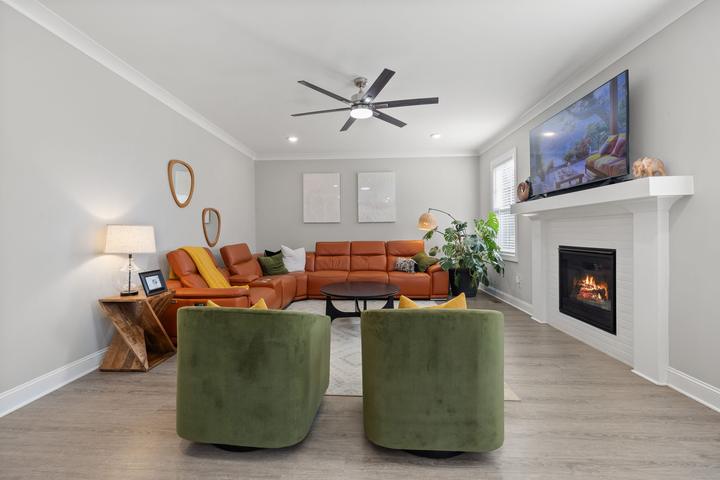
Yes, you can paint fireplace mortar, but only with a high-temperature paint made for stoves and fireboxes, applied to a cold, clean and sound surface. Ordinary wall paint will blister and smell. Paint also hides nothing. Crumbling or cracked joints inside the firebox need repair first, because paint over a failing joint only covers the sign.
Mortar in a firebox is not the same as mortar on a wall
The joints inside a wood-burning firebox take far more heat than any interior wall. The Brick Industry Association describes the combustion chamber as preferably firebrick laid in fireclay mortar, with joints kept thin, about 1/16 to 3/16 inch, to reduce movement and joint deterioration. Brick and mortar here work as one heated surface.
That is why the question is really two questions. Can paint survive the heat, and is the mortar sound enough to be worth painting? A smooth, tight firebox can take a coat of the right paint. A firebox with open, sandy or missing joints cannot be fixed with a brush.
What paint is made for this
Paint sold for walls, trim or masonry is not rated for a firebox and should stay out of it. High-temperature stove paint is the category to look at. The Rutland 1200 degree stove paint data sheet describes a flat black silicone resin paint that resists peeling and blistering up to 1200 degrees Fahrenheit, adheres to clean surfaces without a primer, and says it can be used on bricks in or outside a firebox.
The same sheet gives the limits. Apply it to a cold surface only, never thin it, do not try to cover with one coat, keep it away from heat, sparks and open flame while wet, and provide ventilation the first time the fireplace is fired after painting, because some smoke and odor is given off. It also notes the paint works well with a gas log unit but can blister with a wood fire. Read the label of the exact can you buy, since products differ.
Painting the front: brick, stone, tile, doors and marble
Tile, brick or stone facing
Firebox opening
Wall above the mantel
A fireplace front with its mantel, facing and hearth, simplified and not to scale, with the tile, brick or stone facing picked out in colour.
Outside the firebox the rules relax, but the surface still matters. Brick, stone and tile around the opening can be painted, and the choice of paint is up to you, with one condition. Anything close to the opening gets hot, so stay with a heat-rated product near it and keep a clean margin of bare, noncombustible surface around the opening.
Metal fireplace doors and screens are the easy case. The Rutland sheet lists fireplace tools, grates and andirons among its uses, so a worn black door is a normal job for stove paint. Marble is a different story, because once it is painted the change cannot be undone, and the Rutland sheet does not list stone of that kind among its uses. If the marble is cracked or stained, look at repair before covering it.
How to tell whether the mortar needs repair first
Look at the joints with a flashlight before you open a can. Joints that are flush, hard and uniform can be cleaned and painted. Joints that are recessed, powdery, cracked through or missing pieces are failing. The BIA notes that all exposed mortar joints should be properly tooled, with a concave joint preferred, which is how a sound joint sheds heat and moisture.
Cracks in the back or side wall of the firebox matter more than cosmetic stains. Fire reaching a gap in the firebox wall can reach the structure behind it, and the BIA's design calls for a firebrick chamber isolated from the surrounding brickwork by a 1 inch airspace. You cannot see that airspace, but you can see a crack that runs through a joint and a brick together.
Flush, hard joints: clean, then paint is reasonable.
Powdery or sandy joints: repair first.
Cracks that run through brick and joint: have the firebox looked at before the next fire.
Open gaps wide enough to see light or darkness behind: stop using the fireplace.
Preparing and painting a firebox safely
Soot and creosote film keep paint from bonding. Scrub the surface clean and let it dry fully, then remove loose material. Work only on a cold fireplace, with the room ventilated. High-temperature paint is flammable while wet, so no pilot flames, no cigarettes and no running heater near the work.
Apply thin even coats, and let each dry to the touch before recoating, which the Rutland sheet puts at roughly one to two hours. Let the finish dry a few hours before firing. Start with a small first fire in a ventilated room, since curing gives off smoke and odor. Do not treat that smell as proof the paint failed, and do not treat it as proof that it worked either. Watch for blistering after a few fires.
New masonry and curing
If a firebox has just been rebuilt, the question changes. The BIA advises that no fires be built in a new combustion chamber for thirty days after construction, because earlier fires drive off the moisture the mortar needs to cure. Paint on fresh joints adds a second problem, trapped moisture. Give new work the time the mason calls for before painting.
When to call us about a painted or cracked firebox
If a coat of paint is bubbling, or the joints behind it are loose, the fix is repair, not another coat. The US Fire Administration advises having heating equipment and chimneys cleaned and inspected each year by a professional.
We are a local, family-owned company, Proudly American, and our experienced crew repairs fireboxes in Sarasota homes. Our fireplace repair service covers failing joints, cracked brick and the parts that wear. Ask for a free inspection and a written estimate, and we will tell you plainly whether paint, repair or both makes sense.
Yes, as long as the paint suits the part. Use a high-temperature paint inside the firebox and on anything close to the opening, and a paint chosen for the surface elsewhere. Clean the surface first, and repair cracks or loose joints before any coat goes on.
What is a fireplace mortar?
It is the material that binds the brick or stone of a fireplace. Inside the firebox, the Brick Industry Association prefers firebrick laid with fireclay mortar in thin joints, which handles heat better than ordinary mortar. Outside the firebox, standard masonry mortar is common.
What color to paint brick fireplace?
Color is a style choice, but heat decides the options inside the firebox, where a flat black high-temperature paint is the usual product. For the face of the fireplace, pick a color that works with the room and use a heat-rated paint near the opening. Test a small patch before committing.
Book Within 72 Hours of Your Free Inspection and Save 10%
Any service you book within 72 hours of your free inspection comes with 10% off. The written estimate is free either way.
Damaged firebox surfaces, or another change you have noticed.
Review the recommendation
Understand the proposed task, relevant materials and access.
Authorize the work
Agree on the price and the scope before the paid job begins.
Keep the work record
Retain the component details and any remaining recommendations.
Ready When Your Chimney Is
Call our family-run office in Sarasota for a free inspection, or send the short form and we will call back to set a time. We cover Sarasota and Venice in Sarasota County and Bradenton in Manatee County, and nowhere else.